
 Web pages are no longer expected to stay static after publishing. Today, users expect websites to respond to them, adapt to context, and remain relevant every time they visit. In fact, this expectation has pushed businesses to rethink how they build their websites and portals.
Web pages are no longer expected to stay static after publishing. Today, users expect websites to respond to them, adapt to context, and remain relevant every time they visit. In fact, this expectation has pushed businesses to rethink how they build their websites and portals.
Traditional content management approaches struggle here because business information changes too quickly. Product details evolve, support requirements shift, user intent changes, and operational data updates throughout the day. Static pages simply cannot react fast enough.
That is exactly why Generative Pages are becoming important in 2026.
A Generative Page is a web page that creates or adjusts content in real time using Artificial Intelligence, business rules, user behavior, and connected systems. Instead of showing the same (fixed) information to everyone, the page changes based on who is visiting, what they need, and what’s happening in the business at that moment.
Generative Pages is the Best Solution for Today’s Websites
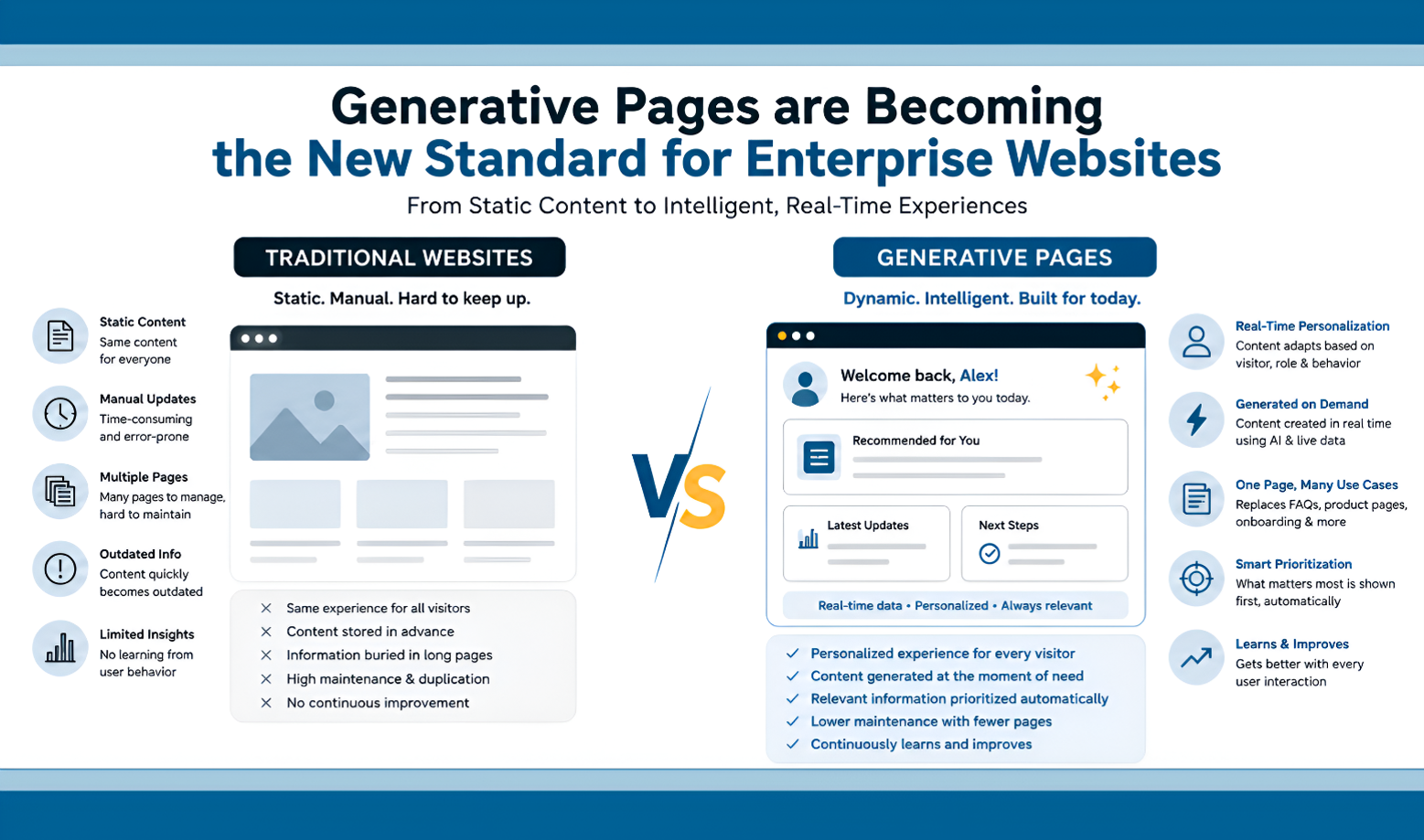
- Generative Pages adapt their content in real time based on the visitor.
One of the biggest advantages of Generative Pages is that the same page can behave differently for different users. This means each visitor sees different headlines, sections, or callouts on the same page. For example, a first-time visitor may see introductory information, key product benefits, and a simple overview. At the same time, an existing customer visiting the same URL may see technical documentation, account-specific recommendations, or onboarding steps. This happens automatically without building separate pages for every audience type.
As a result, businesses avoid creating large collections of duplicate pages that are difficult to maintain. Instead, one intelligent page adjusts itself using visitor behavior, browsing history, user role, or account data
- Content is created at the moment it’s requested and not stored in advance.
Traditional websites primarily depend on prewritten content stored in a CMS (Content Management System). While this works for stable information, it creates delays whenever updates are needed. Generative Pages work differently. Instead of relying solely on fixed text blocks, they dynamically generate content when the page loads. The output is generated using prompts, AI models, connected databases, business rules, APIs, and live system data.
This approach solves a common operational problem faced by enterprise teams: outdated information. For instance, support pages often become inaccurate because product features change faster than documentation updates. Similarly, pricing pages may show old details if updates are delayed across regions or systems. Generative Pages reduce this gap by producing information in real time.
Now, that does not mean businesses completely remove content governance. In fact, enterprise-grade implementations usually define strict rules around:
- Approved content sources
- AI response boundaries
- Compliance filters
- Tone and terminology standards
- Role-based content access
This balance allows firms to stay current while still maintaining control over accuracy and compliance.
- Important information is prioritized automatically for the reader.
Many traditional web pages overload users with long sections of information, assuming everyone will scroll until they find out what matters. In practice, most users want quick, direct answers. Generative Pages improve this experience by automatically prioritizing relevant information. Instead of presenting content in a fixed sequence, the page reorganizes sections based on user context and intent.
For example, if a visitor repeatedly interacts with pricing-related content, the page may surface pricing explanations, implementation details, or ROI information earlier in the layout. This makes the page feel closer to a guided conversation.
A finance leader, IT architect, and operations manager may all visit the same page with completely different expectations. Generative Pages help address this naturally.
- One Generative Page replaces multiple traditional pages.
Enterprise websites often grow into large collections of overlapping pages over time.
There may be separate pages for:
- FAQs
- Product details
- User onboarding
- Technical specifications
- Support guidance
- Use cases
- Troubleshooting steps
And managing all these pages becomes difficult because every update must be repeated across multiple locations. Eventually, inconsistencies start appearing. Generative Pages reduce this problem significantly.
Instead of maintaining many separate pages, businesses can use a single intelligent page that adapts to user intent. The page determines which content to show based on the visitor’s question, behavior, or journey stage. From an operational standpoint, fewer pages also mean better SEO consistency, easier governance, and lower content duplication.
- Pages learn and improve based on how people use them.
User actions influence future responses. A major plus point of Generative Pages is that they improve continuously based on usage patterns. While conventional websites usually improve only after manual analysis, periodic content rewriting, and redesign efforts, Generative Pages shorten this cycle.
The system can track how users interact with content and adjust future experiences accordingly. Sections that receive low engagement may appear less often, while content that consistently helps users can be prioritized more frequently. For example:
- If users regularly skip long introductory sections, the page may shorten them.
- If certain FAQs solve problems faster, they may appear earlier.
- If visitors repeatedly search for the same topic, the page can proactively surface it.
This creates a feedback-driven experience where the website gradually becomes more effective without requiring constant manual restructuring.
Note that businesses still need governance and monitoring. Human oversight remains important to ensure responses stay accurate, aligned with brand standards, and suitable for enterprise use.
Conclusion
As AI tools continue to mature in 2026, the question is no longer whether business websites should be dynamic. The strategy will be how intelligently one can respond to users in real time. Generative Pages change the role of a page from a static content holder to an active interface that adjusts, learns, and stays relevant as situations change.
If your website still relies on static pages and manual updates, now is the right time to rethink how you deliver your content.
And if you’re exploring how Generative Pages can fit into your existing website, internal portal, or any department-specific enterprise platform, UBTI can help you plan and implement it effectively. Just let us know your expectations at info@ubtiinc.com, and our Microsoft-certified specialists will help you assess where generative experiences add the greatest value to your business.
You do not need to rebuild everything at once. Start with one Generative Page, test how users respond, and measure how much manual effort it removes from your daily content operations.
Frequently Asked Questions
1. How are Generative Pages different from dynamic websites?
Dynamic websites mainly pull predefined content based on conditions or database entries. Generative Pages go further by creating or reorganizing content in real time using AI, user intent, and live business data. This makes the experience more adaptive and context-aware.
2. Do Generative Pages require AI training?
3. Are Generative Pages suitable for high-traffic enterprise sites?
Yes, provided the architecture is designed correctly. Enterprises usually combine caching, scalable cloud infrastructure, APIs, and controlled AI processing to ensure that Generative Pages perform reliably even under heavy traffic.
4. How do Generative Pages handle compliance and security?
Enterprise implementations normally include approval workflows, access controls, audit logging, and content filtering rules. Sensitive data access is restricted through permissions, while AI-generated outputs can also be validated before delivery.
5. What skills are needed to build and maintain Generative Pages?
Teams typically need a mix of web development, API integration, AI prompt design, UX planning, and enterprise architecture knowledge. Content marketing and data management also play an important role in long-term maintenance.