The client is a leading garment manufacturer and exporter, serving multinational fashion brands across global markets. The company has grown from a single manufacturing unit into a large-scale garment manufacturing business with production facilities across the country. Its operations emphasize sustainable practices and ethical manufacturing, while continued investment in technology and production capabilities supports its plans for further global growth.
Client
The client is a leading garment manufacturer and exporter, serving multinational fashion brands across global markets. The company has grown from a single manufacturing unit into a large-scale garment manufacturing business with production facilities across the country. Its operations emphasize sustainable practices and ethical manufacturing, while continued investment in technology and production capabilities supports its plans for further global growth.
Challenges Faced by the Client
The client’s garment supply chain spans Merchandising, Planning, Fabric, Import, Commercial, Warehouse/QC, and Production. Teams manage their respective activities through an in-house .NET-based ERP, while email and Excel are also used to coordinate with internal teams and suppliers. The process covers order creation, material planning, fabric allocation, production tracking, and shipment, but information is not always captured or updated in one place. As a result, teams relied on manual updates and follow-ups to track orders and materials, creating the following gaps:
- Incomplete supply chain tracking in ERP: The in-house ERP doesn’t support end-to-end tracking from order creation through to shipment, and several categories of data are not updated in the system promptly, creating a direct risk of delayed deliveries to clients.
- Manual, email-driven coordination: Letter of Credit corrections, supplier confirmations, and shipment delay updates (ETD/ETA) are communicated over email between internal teams and suppliers, with no centralized dashboard or audit trail.
- Lack of proactive delay alerts: The process didn’t automatically flag cases where raw materials were expected to arrive later than the planned sewing start date. Delays were typically discovered only after they had already impacted the production line.
- Manual fabric allocation tracking: Fabric balance, soft allocation against Production Cut Dates (PCDs), and prioritization across multiple deliveries were manually tracked in Excel, which didn’t scale with order volume and was prone to version and human error.
- Reporting lag and single-person dependency: Each week, one person ran SQL queries, cross-checked the ERP data, and updated the Excel report before their recap meeting. Although Superset provided near-real-time monitoring, business users still had to wait for the weekly report when they needed quick answers to questions not covered by the existing view.
- Legacy infrastructure: The client runs on a basic-tier SQL Server 2012 license and was looking to modernize its entire supply chain system onto a cloud platform with AI enhancement to optimize the workflow and enable real-time analytics and order tracking.
Solutions
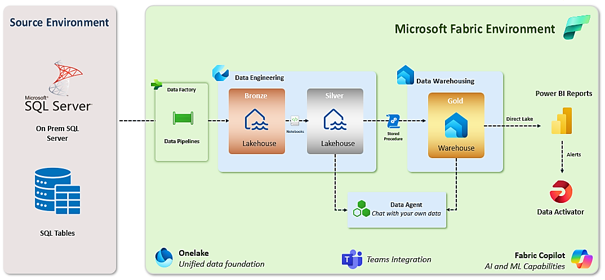
The technical specialists at UBTI first mapped the client’s existing supply chain process across various phases, including how data moved through the in-house ERP and how it supported Excel- and email-based activities. Based on these requirements, the approach was to retain the existing ERP as the system of record while creating a governed data and analytics layer around it. The solution was therefore designed as a Microsoft Fabric-based platform that connects the existing process from source data through:
- Real-time data integration: The client’s on-premises SQL Server database is integrated with Microsoft Fabric using a metadata-driven incremental load approach through an on-premises data gateway. The solution captures inserts, updates, and source deletions, ensuring that all data changes from the existing ERP are accurately synchronized with Fabric without disrupting the source system, while the ERP remains the system of record.
- Governed medallion architecture: Once the data enters Fabric, it moves through a layered Medallion Architecture across the Fabric Lakehouse/Warehouse:
- Bronze Layer: Raw data is ingested as-is from the source.
- Silver Layer: Data is cleaned, validated, and standardized.
- Gold Layer: Business-ready, aggregated data is prepared for consumption by AI and Power BI activities, with Direct Lake mode powering fast Power BI reports.
- AI data agents: Using Microsoft Fabric Data Agent and Microsoft Copilot Studio, an AI-powered chatbot is integrated with Microsoft Teams, enabling management and business users to ask natural-language questions about order status, material delay risks, fabric balance, and other supply chain information. Answers are generated from the available live data, reducing dependency on separate reports.
- Advanced Raw Material Availability Tracker: The client’s existing manual weekly recap Excel chart was migrated into a purpose-built tracker with improved visualizations, giving Planning and Fabric teams a live view of Purchase Order-to-Production Cut Dates allocation, material critical dates, and delay flags in one place.
- Root-cause delay diagnostics: To support the existing supply chain review process, the report itself highlights each order along with the reason for its delay (including which data was entered incorrectly and which mappings are misconfigured). With this level of detail, the client can work with their development team to correct the underlying database entries.
- Proactive alerts: The process is completed with proactive alerting through Data Activator. This is configured to raise alerts when materials are projected to arrive after the Material Critical Date of a Production Cut Date, closing the gap left by the current process, where delays are only detected after they occur.
This engagement is scoped as a focused months build, sized to an F4 Fabric capacity with 1 TB of OneLake storage. The architecture is also designed to allow the Fabric capacity to be scaled up as data volume and reporting demand grow.
Solutions Benefits
With supply chain information brought together in Microsoft Fabric, client teams can now track orders, materials, and production status through a shared, up-to-date view rather than relying on separate ERP screens, emails, and Excel files. As a result:
- Teams can identify material delays earlier: Planning and Fabric teams can see soft-allocated material against each Production Cut Date, along with automatic delay flags when a supplier’s predicted arrival falls after the Material Critical Date. This helps teams identify potential delays before they affect production, rather than discovering them after the fact.
- Fabric tracking no longer depends on Excel: Fabric balance, allocation priorities across urgent & standard deliveries, and excess or shortage handling are managed through a single, current tracker instead of separate Excel records. This makes it easier for teams to keep allocation information aligned as order requirements change.
- Weekly reporting no longer depends on one person: The Advanced Raw Material Tracking Report removes the manpower previously required to prepare the weekly Excel report. Business users can view Sales Order status live at any time, without waiting for the recap report or depending on a staff member to prepare the latest report.
- Business users can get answers faster: Using Microsoft Teams, users can directly ask questions about order, shipment, or material status instead of requesting a report and waiting for it to be compiled. This provides faster access to the information needed for day-to-day decision-making.
- Teams now work from a shared view: Merchandising, Planning, Fabric, Import, Commercial, Warehouse/QC, and Production teams work from the same real-time dataset, reducing duplicated tracking and mismatched status reports due to isolated views.
- The platform supports future AI and ML use cases: Since the existing ERP data is integrated into OneLake rather than replacing the ERP, the same foundation can support future AI/ML use cases such as delay prediction and consumption forecasting without requiring a major redesign.
Conclusion
The client’s garment supply chain relied on ERP data, emails, and Excel, making it difficult to maintain a clear, up-to-date view of orders and materials. This increased reporting effort, delayed visibility into supply issues, and required frequent manual follow-ups. UBTI addressed this by connecting the existing ERP with Microsoft Fabric and bringing supply chain data into a governed platform for reporting and AI-assisted access. Teams can now track the supply chain through a shared view, identify material issues earlier, and access current information without relying on manually prepared reports. UBTI continues to help garment and textile manufacturers address supply chain challenges by connecting their existing processes with better data visibility and reporting capabilities.