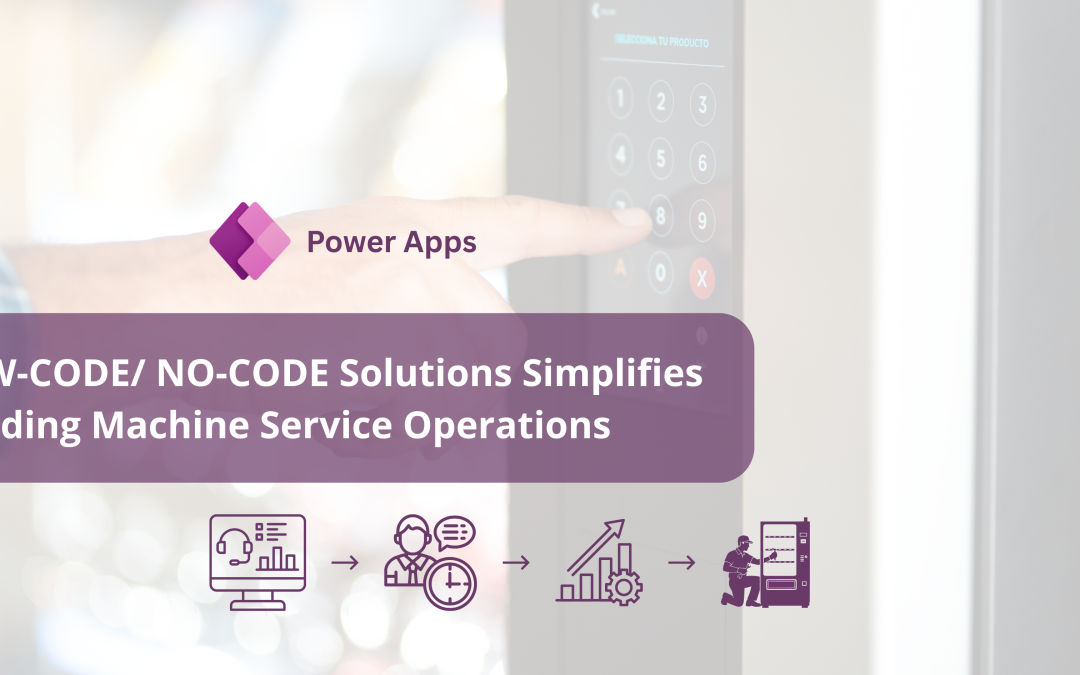

A case study on how service requests that once took hours to reach technicians are now available instantly with a Low-Code/No-Code solution, improving customer satisfaction and first-visit fix rates.
The Client
The client is a long-standing, family-operated business with over 40 years of experience, providing complete food and beverage services across domains. Starting with vending machines, the company has steadily grown into a full-service breakroom solutions provider, offering vending, micro-markets, office coffee, pantry services, bottled water, water filtration systems, and ice machine rentals. Today, they support thousands of customers across offices, hospitals, schools, warehouses, and call centers, and are known for their customer-first approach and dependable service model.
Challenges Faced by the Client
The client’s operations depend on technicians who travel to customer sites to fix equipment problems such as cooling faults, electrical concerns, or vending machine malfunctions. Whenever a customer reports a problem, a “service ticket” (a digital record of the complaint with all the job details) is created, assigned to a technician, and updated until the work is complete.
However, their existing process for managing these service calls was tedious and had the following challenges:
- No Direct Way to Assign or Track Tickets: Service requests were first entered into the company’s internal SEED application, but this could only be done from the office. Technicians in the field had no direct way to receive new job tickets or update progress in real time.
- Delayed Communication: Job details (such as the type of problem, customer address, and equipment asset ID) were sent to technicians by email or messaging apps. This often caused delays because technicians might check them late or miss them entirely.
- Unclear Customer Location: Technicians had to search on-site manually for the customer’s exact location, wasting valuable time.
- Scattered Job Evidence: Technicians were expected to share proof of completion, such as photos of the equipment after repair. These were mainly sent over WhatsApp or email, making it hard for managers to centralize or link them to the correct job record.
- Limited Daily Visibility: Managers lacked a proper tracking system to know how many jobs were open or completed. This made it hard to plan technicians’ schedules and prioritize urgency.
Solutions
To make the entire process faster, more accurate, and easier to manage, our experts at UBTI built two custom applications using Microsoft Power Apps as part of their Low-Code/No-Code solutions approach. These apps allowed the technicians and office staff to work in sync without relying on tools or updates. Here is how the solution works:
- Purpose-Built Apps: Instead of trying to handle both job creation and field updates in a single app (which could cause data sync issues), 2 separate applications were developed:
- Ticket Management App: For office staff to create new service tickets or modify existing ones.
- Service Operations App: For technicians to view and update their assigned job status in real time.
- Real-Time Ticket Assignment and Updates: As soon as a ticket was created in the Ticket Management App, it appeared instantly in the Service Operations App. This gave technicians immediate access to all relevant details, including the customer’s name, address, equipment type, fault description, and urgency level.
- Ticket Status Management: Each job can be marked as Open, Closed, or Reopened. If a closed job developed a new issue later, it could be moved back to Open status with one click.
- Map Integration for Easy Navigation: The Service Operations App included a Google Maps feature that pinpointed the customer’s location. Technicians could tap the map icon to start navigation and see job details within the map view.
- Language Translation for Notes: Since technicians spoke different native languages, a translation feature was added in the Notes section. They can type in their language, which auto-translates to English for the managers.
- Mandatory Job Completion Steps: When closing a ticket, the app requires technicians to fill in specific fields such as resolution notes, reason for closure, and attach supporting photos of the repaired equipment. These fields were mandatory to prevent incomplete records.
- Automatic Notifications to Supervisors: A “Notify Point of Contact” option triggered a Power Automate flow, sending an email with all job details, updates, and attachments to the assigned supervisor. This ensured managers stay informed without manual follow-ups.
- Daily Job Summary Emails: At the end of each day, a bot generates and emails a summary showing the number of jobs opened, closed, and reopened, giving management transparency.
- Automated Ticket Creation Based on Maintenance Cycles: For recurring service needs, the bot monitors the “Next Filter Run Date” from the Recurring Filter Billing report. Service tickets were automatically created 14 days before so technicians could plan work in advance.
Solutions Benefits
The new Power Apps-based system eased out the client’s overall field operations, delivering the following benefits:
- Quicker Fault Resolution: Service teams could now act on issues within minutes of receiving them, reducing customer downtime and improving service turnaround time.
- Higher First-Visit Fix Rate: With all the ticket details available before reaching on-site, technicians could carry the right tools and spare parts, increasing the chance of fixing the problem in one visit.
- Better Resource Utilization: Managers could see which technicians were available, how many jobs they had, and assign tasks accordingly, avoiding overloading some while others were idle.
- Reduced Customer Frustration: Customers no longer had to repeatedly explain the same issue, as all complaint history and past fixes were visible to the technician on arrival.
- Better Location Accuracy: Google Maps integration allowed technicians to find the customer site without confusion, reducing travel time and missed visits.
Conclusion
The Service Operations solution shifted the client’s field service process from slow and manual to quick and organized. Technicians could get new jobs right away, find customer locations easily, update progress while on-site, and complete all closure steps without missing anything. The client was highly satisfied with the solution, as it made their work faster, more accurate, and easier for the office team and technicians. UB Technology Innovations, Inc. continues to provide Low-Code/No-Code solutions that speed up vending machine repairs, keep machines running, and ensure customers receive uninterrupted service.
About Us
UB Technology Innovations, Inc. (UBTI) is a leading global technology solution provider with over 3 decades of experience across all industries, specializing in Capital Markets, Logistics, and Healthcare. We are the preferred Microsoft Solutions Partner backed by a world-class team of Microsoft Certified experts with rich experience in Azure Cloud Platform and Data Analytics.