
A case on how a hospital modernized operations using Microsoft Fabric, combining integration, reporting, and governance in one solution.
The Client
The client is one of the earliest private hospitals in the Middle East, with a solid foundation in maternal and child healthcare. Over the years, it has earned a reputation for delivering compassionate, high-quality care rooted in integrity and community values. The hospital provides a wide range of services supported by a skilled and dedicated team. It maintains international accreditations and is recognized for meeting global standards in clinical excellence.
Challenges Faced by the Client
Having all data accessible from a single point is more than convenience in a hospital. It is essential for safe, timely, and effective care. Without centralization, important clinical decisions get delayed, inconsistencies arise, and coordination between departments breaks down. The client faced exactly that issue, as outlined below:
- Disconnected Data Systems: 4 different platforms were being used for storing different types of data:
-
-
- Oracle contained the patient and hospital’s historical records, with recent data being stored in InterSystems-Iris.
-
-
-
- WebHRSystems handled employee records and payroll information.
-
-
-
- SAP is used for financial data.
-
Since none of these systems were integrated, it was difficult to combine or analyze data consistently.
- Multiple Reporting Tools with No Centralized Access: Reports were created using Qlik Sense, SAP Analytics Cloud (SAC), and Excel. These tools required separate access and licenses and did not follow a unified structure for user permissions. This made it hard for teams to get the information they needed from other departments and created unnecessary delays.
- Reports were not Refreshed Daily: Many operational and clinical reports were based on outdated data. Since automatic daily refreshes weren’t in place, there were delays in accessing the most recent numbers, which affected planning, resource allocation, and internal decision-making.
- High Operational Costs: Maintaining multiple tools and data environments meant increased licensing costs and administrative effort. It also made the overall reporting process slower and harder to scale.
Solutions
We implemented a fully connected data and reporting platform for ingestion, transformation, reporting, and governance within Microsoft Fabric to resolve these challenges. Here is the structure:
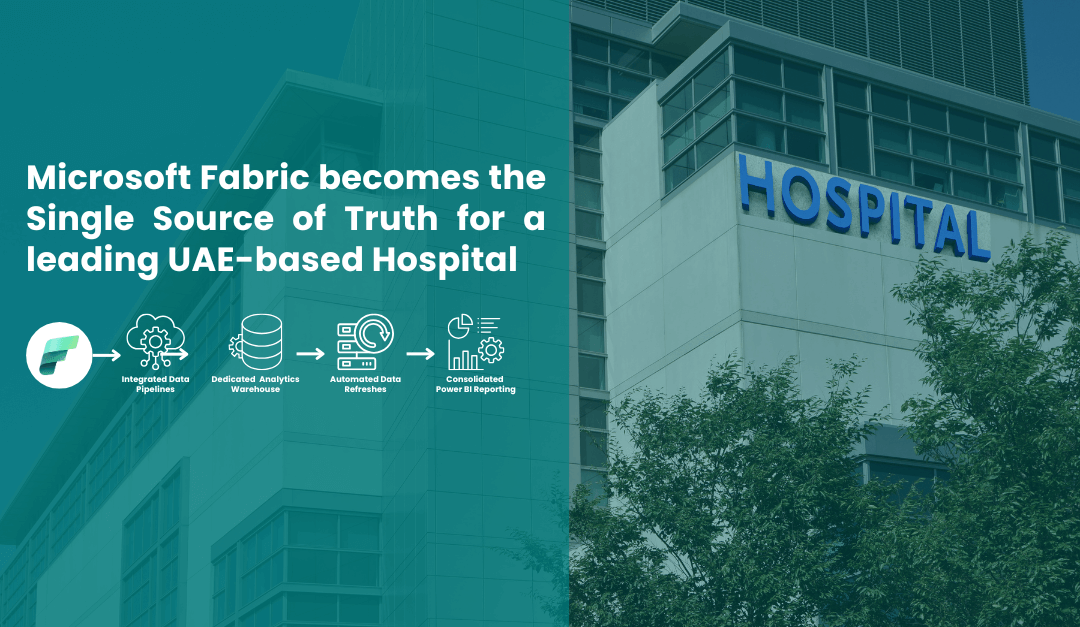
- Data Integration: We connected the client’s 4 primary systems to Microsoft Fabric using built-in Data Pipelines and Notebooks. This allowed data from each system to flow into one central environment automatically, eliminating the need for manual exports.
- Dedicated Analytics Warehouse: A high-performance warehouse is set up in Microsoft Fabric to manage reporting and analytics. This kept reporting separate from day-to-day systems, so performance stayed smooth, and reports could be generated quickly, even with large amounts of data.
- Automated Data Refreshes: Scheduled refreshes were set up (daily for operational data and weekly for longer-cycle reports) using Fabric’s built-in scheduling features. This was done to ensure reports always reflected the latest patient, HR, and financial data needed for daily planning and compliance.
- Unified Semantic Model: A common semantic model was created to define KPIs, metrics, and business logic. This ensured that everyone (clinical teams, finance, HR) used the same definitions when building or consuming reports.
- Consolidated Reporting: Existing reports from Qlik Sense, SAC, and Excel were migrated to Power BI within Microsoft Fabric. This removed the need for multiple tools and gave users one place to access all reports with a consistent interface.
- Role-Based Access Control: Specific security rules were established so that users only saw data relevant to their role. This aligns with compliance needs like HIPAA and NABH, while keeping access fast and straightforward for authorized users.
Solutions Benefits
The move to Microsoft Fabric significantly improved the hospital’s data setup and changed how fast, accurate, and reliable their operations became:
- Faster Report Development: Over 70 Government-mandated Jawda reports were delivered within just one month of going live. The new setup allowed teams to build, validate, and publish reports much faster than before.
- On-Demand Departmental Reporting: With a unified semantic model, departments like HR, finance, and clinical teams could independently generate reports using consistent metrics, reducing back-and-forth with IT and improving internal efficiency.
- Single Source of Truth: All enterprise data is now accessible in one place. This eliminated silos and allowed leadership to get a complete picture of operations in real-time.
- Lower Total Cost of Ownership (TCO): By retiring Qlik Sense and SAC, the client reduced its licensing costs and simplified its IT infrastructure, leading to long-term savings.
- Future-Ready Architecture: The entire solution was built with flexibility in mind. The platform can now support new data sources, changes in regulatory reporting, or advanced use cases like AI and machine learning, without needing complete rework.
Conclusion
By consolidating data, automating refreshes, and enabling secure, role-based reporting, the solution directly aligned with the client’s operational and compliance needs. Noticeably, the hospital saw immediate value in faster, more reliable reporting, especially with critical government submissions completed in record time. With deep expertise in Microsoft Fabric, UB Technology Innovations, Inc. continues to help hospitals modernize data workflows with speed, accuracy, and compliance.
About Us
UB Technology Innovations, Inc. (UBTI) is a leading global technology solution provider with over 3 decades of experience across all industries, specializing in Capital Markets, Logistics, and Healthcare. We are the preferred Microsoft Solutions Partner backed by a world-class team of Microsoft Certified experts with rich experience in Azure Cloud Platform and Data Analytics.

Winner of the prestigious Azure
Synapse Hackathon 2021 award

One of the Top 10 winners of the
Microsoft’s Azure AI & ML Workathon