Our client is a leading global tyre manufacturing company relies heavily on SAP for their operational data and utilizes Power BI for data analytics and decision-making.
The Client
Our client is a leading global tyre manufacturing company relies heavily on SAP for their operational data and utilizes Power BI for data analytics and decision-making.
Challenges Faced by the Client
Before Fabric, our client grappled with several complex challenges in their data management and analytics processes. Firstly, integrating diverse data sources from SAP Business Warehouse into Power BI was challenging due to SAP’s complex data structures and formats. Additionally, their existing data flows, especially using Dataflow Gen1, resulted in extended refresh times averaging over 40 minutes per cycle, delaying access to critical business insights. Importing large semantic models led to high storage consumption and inefficient daily refresh cycles, further impacting operational efficiency. Managing yearly cube date parameter expansions and regular maintenance of archive data flows were cumbersome tasks, complicating data analysis timelines and data availability, respectively.
Solutions
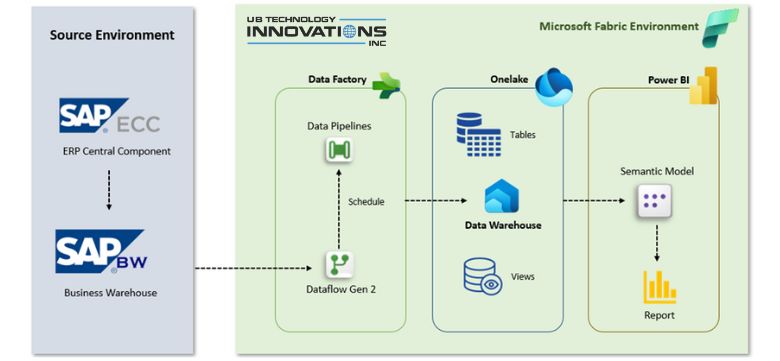
To overcome SAP Business Warehouse integration challenges and improve Power BI reporting efficiency, the client adopted Microsoft Fabric. This included leveraging Dataflow Gen2 for streamlined data ingestion into the data warehouse and developing a custom semantic model for optimized analytics. Automated data pipelines enabled real-time incremental loads, eliminating manual maintenance and ensuring timely updates. Fabric’s scalable architecture accommodated growing data volumes seamlessly, while optimizing file sizes and accelerating data refresh rates, leading to enhanced operational efficiency and faster decision-making capabilities.
Solutions Benefits
2. Integration with Microsoft Ecosystem: Fabric seamlessly integrated with existing Microsoft tools like Power BI, allowing for continued use and expanded functionalities.
3. Increased Visibility and Data-Driven Decisions: Fabric provided a centralized platform for data visibility and empowered data-driven decision-making at all levels of the organization.
4. Improved Reporting Efficiency: Fabric allowed for the creation of dynamic reports that were easily refreshed and accessible to authorized users, saving valuable time and resources.
5. Enhanced Data Governance and Security: Fabric’s built-in security features ensured data accuracy and consistency. Access controls and data lineage capabilities improved data governance and provided a clear audit trail.
6. Greater Scalability and Flexibility: Fabric offered a scalable architecture that could accommodate future data growth, providing flexibility for the organization’s evolving needs.