

A case study on how UBTI enabled a financial services firm to automate high-volume attendance checks, giving leadership instant visibility into HOD performance.
The Client
The client is a top-tier non-banking financial services group providing solutions across cross-border payments, foreign currency exchange, bill collection, and payment technologies for both consumers and businesses. They serve a diverse clientele, including retail clients, inbound and outbound travelers, SMEs, large enterprises, financial institutions, and global partners. The group invests continuously in technology and customer experience, building a network of physical branches supported by digital platforms. The client aims to make financial services accessible, secure, and easy to use for all in the long run.
Challenges Faced by the Client
Our client runs a weekly attendance verification process for more than 30 Heads of Departments (HODs) to ensure working hours of their team members are accurately recorded and reviewed at a leadership level.
To prepare this weekly report, the HR team must collect attendance information from several systems. Daily punch-in and punch-out data is sourced from RAMS, leave and deviation details are pulled from HRMS, and Face Recognition logs are received separately via email. Additionally, attendance for some employees operating from other regions is manually added so that the report reflects the complete picture. Once all inputs are gathered, the data is consolidated, reviewed, and circulated for approvals.
In practice, executing this workflow every week became increasingly difficult due to:
- Manual Consolidation across Multiple Data Sources: HR teams had to download, clean, and combine data from different systems every week, making the process time-intensive and repetitive.
- Risk of Errors in Attendance Calculations: Working hours, deviations, leave adjustments, and compensatory offs were validated manually, increasing the possibility of incorrect totals or mismatches.
- Strong Dependency on Timely Inputs from Other Teams: The process depended on timely inputs from IT and regional HR teams. If even one data source was delayed, the entire report cycle was pushed back.
- Limited Visibility during Review and Approval: Once reports were shared, reviewers had no interactive way to explore the data. Any clarification required back-and-forth communication with the HR department.
- Difficulty in Sustaining the Process: As the number of departments and stakeholders grew, the weekly manual effort increased, making the attendance verification process hard to sustain without additional resources.
Solutions
After closely reviewing our client’s HOD attendance verification process, the team at UBTI understood that the main concern here was the human effort required to collect, validate, and circulate all this data every week. Drawing from our experience in building automation for complex, multi-source processes, we recommended a Microsoft Power Automate bot as the ideal approach to remove this manual dependency by:
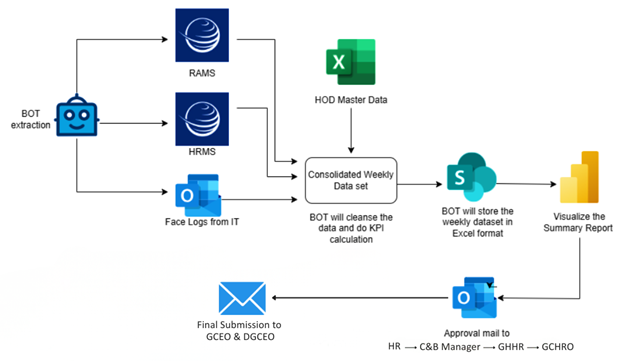
- Automating Weekly Data Collection: Every Monday, the Power Automate bot is triggered to collect the previous week’s attendance data directly from the RAMS portal and the HRMS system. In parallel, it checks Outlook for the Face Recognition data email sent by IT to HR and automatically retrieves the attachment.
- Handling Missing Inputs Appropriately: If the face recognition email is not received on time (on Sunday), the bot emails a reminder to both HR and IT teams (on Monday), ensuring the weekly process does not stall due to missing data.
- Centralizing all Raw Data in SharePoint: All downloaded files are stored in SharePoint with clear naming conventions and date references. This creates one reliable location for weekly attendance, eliminating confusion caused by scattered local files and email attachments.
- Cleaning and Validating Attendance Data Automatically: The bot processes the raw files by removing unnecessary columns, standardizing formats, and applying attendance rules to calculate worked hours, deductions, deviations, and comp-offs, eliminating manual Excel calculations.
- Creating a Consolidated File: Once cleaned, all data is merged into a single consolidated Excel file in SharePoint. This file represents the final verified dataset for all HODs for that week.
- Visualizing Insights through Microsoft Power BI: Power BI reads the consolidated data and refreshes the dashboard automatically. HR and stakeholders can review summaries, drill into individual HOD records, and validate attendance details directly through the dashboard.
- Automating Step-by-step Approvals: Once the dashboard and reports are ready, the bot sends the dashboard link, its PDF version, and the consolidated file to HR for the first review. After approval, the approved data moves through C&B Manager, GHHR, and GCHRO. The bot finally submits the Power BI dashboard link and the PDF to senior leadership (i.e., GCEO and DGCEO).
Solutions Benefits
The new Power Apps-based system eased out the client’s overall field operations, delivering the following benefits:
- Quicker Fault Resolution: Service teams could now act on issues within minutes of receiving them, reducing customer downtime and improving service turnaround time.
- Higher First-Visit Fix Rate: With all the ticket details available before reaching on-site, technicians could carry the right tools and spare parts, increasing the chance of fixing the problem in one visit.
- Better Resource Utilization: Managers could see which technicians were available, how many jobs they had, and assign tasks accordingly, avoiding overloading some while others were idle.
- Reduced Customer Frustration: Customers no longer had to repeatedly explain the same issue, as all complaint history and past fixes were visible to the technician on arrival.
- Better Location Accuracy: Google Maps integration allowed technicians to find the customer site without confusion, reducing travel time and missed visits.
Conclusion
The Service Operations solution changed the client’s field service process from slow and manual to quick and organised. Technicians could get new jobs right away, find customer locations easily, update progress while on-site, and complete all closure steps without missing anything. The client was highly satisfied with the solution, as it made their work faster, more accurate, and easier for the office team and technicians. UB Technology Innovations, Inc. builds solutions that make vending machine repairs faster, keep machines working, and ensure customers get uninterrupted service.
About Us
UB Technology Innovations, Inc. (UBTI) is a leading global technology solution provider with over 3 decades of experience across all industries, specializing in Capital Markets, Logistics, and Healthcare. We are the preferred Microsoft Solutions Partner backed by a world-class team of Microsoft Certified experts with rich experience in Azure Cloud Platform and Data Analytics.

